 中文
 ENGLISH
Classification of Plastic Pelletizing Lines
1. Classification by Feeding Method
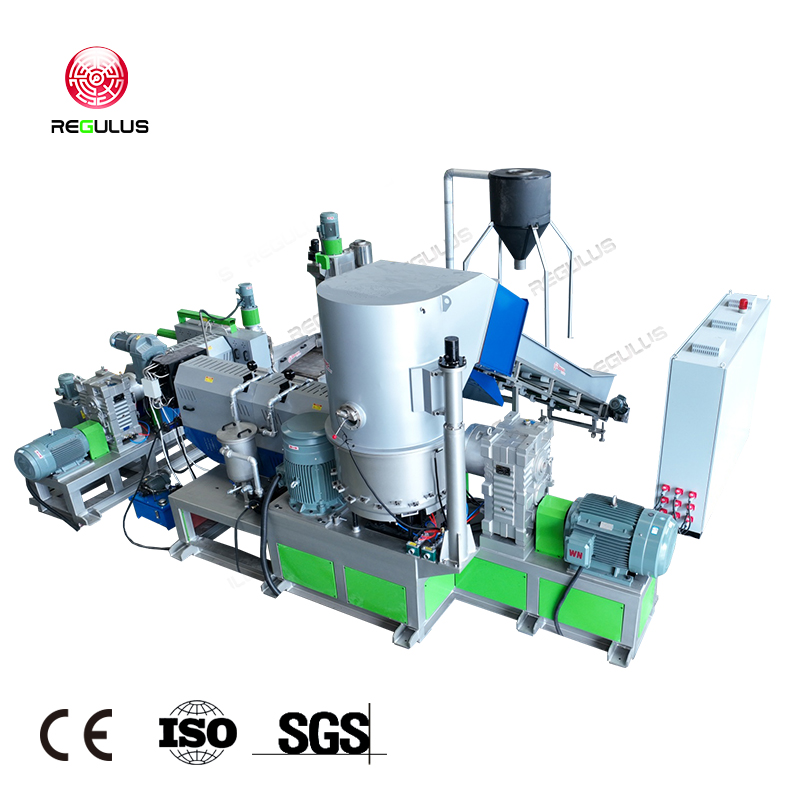
| Type | Suitable Materials | Description |
|---|---|---|
| 1.1 Compactor Feeding Pelletizing Line | Soft materials such as plastic films and bags | The compactor performs a function similar to an agglomerator,but it is integrated above the extruder. |
| 1.2 Conventional Feeding Pelletizing Line | Rigid plastics and agglomerated materials | Plastic materials are fed directly into the extruder through a conventional feeding system. |
2. Classification by Number of Extruders
| Type | Suitable Materials | Description |
|---|---|---|
| 2.1 Single-Stage Pelletizing Line | Clean raw materials | Equipped with one extruder. |
| 2.2 Two-Stage Pelletizing Line | Slightly contaminated materials, materials containing some moisture, or applications with higher quality requirements | Equipped with two extruders for additional melting, mixing, and filtration. |
3. Classification by Pelletizing Method
| Type | Pellet Shape | Suitable Materials |
|---|---|---|
| 3.1 Water-Ring Pelletizing | Round pellets, approximately Φ3 × 5 mm | PE, HDPE, and LDPE |
| 3.2 Strand Pelletizing | Elongated, cylindrical pellets | Plastics with higher melt viscosity, such as PP, PS, and ABS |
Some customers prefer water-ring pelletizing lines because they require less floor space.
The final configuration depends on the customer's requirements and
raw material conditions. We recommend the most suitable solution
based on these factors.
I. Introduction to the Compactor Feeding Pelletizing Line
The compactor feeding pelletizing line is a semi-automatic continuous production line
mainly consisting of a belt conveyor, compactor, extruder, screen changer, water-ring
pelletizing (or strand pelletizing) system, dewatering machine, pneumatic conveying
system, and storage hopper.
Belt Conveyor
The belt conveyor continuously feeds materials into the compactor, ensuring a
steady material supply while reducing the need for manual feeding.
Compactor (Similar in Function to an Agglomerator)
After plastic materials are fed into the compactor chamber, the high-speed rotating
blades work together with the stationary blades to cut the materials into smaller pieces.
Under the centrifugal force generated by the rotating blade disc, the shredded
materials move along the inner wall of the chamber. At the same time, the materials
are continuously circulated and turned over by the rotating blades, moving from the
outer edges toward the center of the chamber.
High-speed friction between the materials themselves, the chamber wall, and the
blades generates a large amount of heat. As the temperature rises rapidly, the
materials reach a semi-plasticized state and begin to stick together into small
agglomerates.
Before the materials form large lumps, the guide plate directs them into the extruder
for further melting, plasticization, and pelletizing.
The discharge outlet of the cutting compactor is directly connected to the extruder
feed inlet. When the materials reach a semi-plasticized state through the shearing
action of the rotating and stationary blades, they enter the extruder barrel through
the feed opening.
Extruder
The rotating screw pushes the material forward through the barrel, where it is melted,
plasticized, and finally extruded.
The screw rotation compresses, melts, and thoroughly mixes the plastic in pellet or
powder form.
The barrel houses the screw and the plastic material. Its inner surface undergoes
heat treatment to provide good wear resistance and a certain degree of corrosion
resistance.
Heating elements are installed on the outer surface of the barrel, transferring heat
to the plastic to facilitate melting and plasticization. Temperature sensors installed
along the barrel allow automatic temperature control within a range of 0–300°C to
meet different plastic processing requirements.
Water-Ring Pelletizing
The water-ring pelletizing system is primarily used for cutting molten plastic into
pellets. The main shaft drives the blade holder at high speed, keeping the blades
close to the pelletizing die.
The shaft speed can be adjusted according to the required pellet size, allowing
pellets of different sizes to be produced.
After cutting, the pellets enter the circulating water ring, where they are cooled.
The water and pellets then flow together through the water collection tray into
the dewatering machine.
This process provides rapid cooling and helps prevent the pellets from sticking
together due to insufficient heat dissipation.
Dewatering Machine
The dewatering machine is mainly used to remove water from freshly produced
plastic pellets.
The high-speed rotating shaft generates centrifugal force, throwing the mixture
of plastic pellets and water toward the screen. Water passes through the screen
and is discharged, while some fine particles may also be carried out with the
water.
The plastic pellets are conveyed by the dewatering rotor and discharged through
the outlet for the next processing stage.
The bearings feature a water-cooling structure that improves heat dissipation,
reduces bearing temperature rise, and significantly extends bearing service life.
II. Introduction to the Conventional Feeding Pelletizing Line
The conventional feeding pelletizing line is a semi-automatic continuous
production line mainly consisting of a screw feeder, extruder, screen changer,
water-ring pelletizing (or strand pelletizing) system, dewatering machine,
pneumatic conveying system, and storage hopper.
Screw Feeder
The screw feeder is an auxiliary machine used in plastic processing. It
automatically conveys crushed rigid plastics, powdered materials, or
granular plastic raw materials directly into the extruder hopper.
Downstream Equipment
The extruder, water-ring pelletizing system, and dewatering machine
work in the same way as those described in the compactor feeding
pelletizing line above.
Extrusion
The upstream equipment remains the same as that used in the
water-ring pelletizing line. The main difference is in the pelletizing
section.
The water-ring pelletizing system, dewatering machine, pneumatic
conveying system, and storage hopper are replaced with a cooling
water trough, air blower, strand pelletizer, pneumatic conveying
system, and storage hopper.
Cooling Water Tank
The cooling water trough is used to cool the plastic strands extruded
from the extruder.
The trough is filled with water through the water inlet and is equipped
with four nylon support rollers. The first three rollers should be
submerged in the water, while the fourth should be positioned above
the water surface.
These rollers mainly guide the plastic strands. Each roller has circular
grooves that help distribute the strands evenly and prevent them from
sticking together during rapid cooling.
Air Blower
The air blower removes some of the surface moisture from the plastic
strands after they pass through the cooling water trough, allowing
them to enter the next piece of equipment more smoothly.
Strand Pelletizer
The strand pelletizer cuts the cooled plastic strands into small pellets.
It mainly consists of two sections: the rotary cutting section and the
drive section. The machine uses a variable-frequency drive (VFD) to
control the cutting speed, enabling stepless speed adjustment.